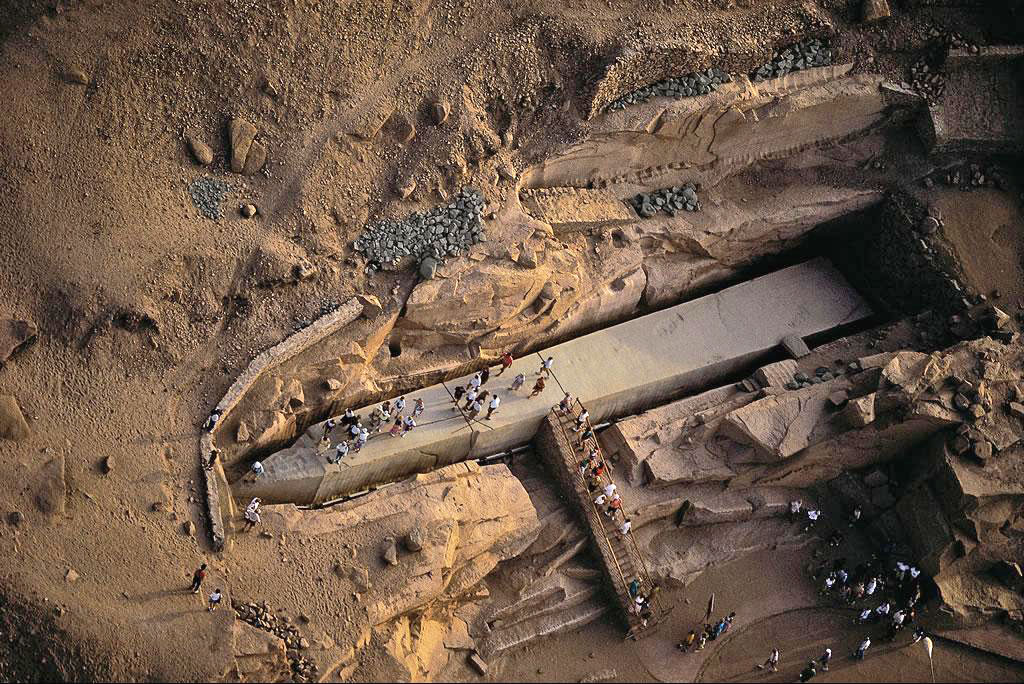
Welcome to the Unfinished Obelisk — one of the most extraordinary and revealing ancient sites in Egypt, lying exactly where it was abandoned 3,500 years ago in the granite quarries of Aswan.
This obelisk, if completed, would have been the largest ever carved — approximately 42 meters tall and weighing nearly 1,200 tonnes. It was commissioned by Queen Hatshepsut, Egypt's great female pharaoh, around 1500 BC to stand at the Temple of Karnak in Luxor.
But as the carving progressed, cracks appeared in the granite. The obelisk was abandoned where it lay, still connected to the bedrock at its base — and because it was never moved or reused, it has remained here for three and a half millennia, a perfectly preserved record of ancient quarrying techniques.
What makes this site so extraordinary is what it reveals about how the Egyptians worked. You can see the chisel marks left by the workers' tools — the ancient Egyptians did not have iron tools; they used dolerite pounding stones, harder than the granite itself, to grind away the rock around the obelisk. Thousands of workers, working in teams, pounded and chiseled through solid granite using nothing but stone tools, water, and human muscle.
The quarries of Aswan supplied granite for monuments across Egypt — the sarcophagi of the pharaohs, the colossal statues, the obelisks that now stand in Rome, Paris, London, and New York all began as raw stone in these pink granite outcrops.
Standing beside the Unfinished Obelisk, you are standing at the very source of ancient Egypt's monumental ambition — the place where the stone was born.