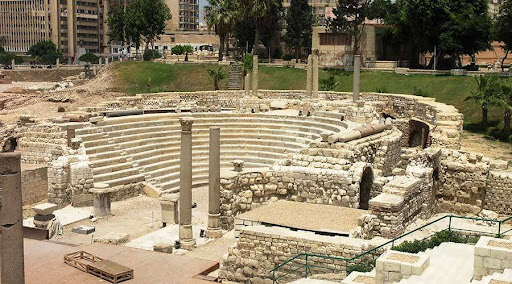
Welcome to the Roman Theater of Alexandria — the only Roman theater ever discovered on Egyptian soil, and one of the finest examples of Roman civic architecture in Africa.
The theater was discovered in 1960 during excavations in the Kom el-Dikka area of central Alexandria — a major archaeological site that continues to yield new discoveries beneath the modern city. The theater dates to the 2nd century AD, during the height of Roman rule over Egypt.
The structure is remarkably well preserved. Thirteen semicircular rows of white and gray marble seating rise in a gentle curve around the central stage area, with capacity for approximately 800 spectators. The marble was imported from across the Roman world — some columns show veining characteristic of quarries in Asia Minor and Greece.
Archaeologists have also uncovered, around the theater, the remains of a Roman residential quarter — villas with mosaic floors, baths, lecture halls, and streets — giving a vivid picture of daily life in Roman Alexandria. This was clearly a prosperous, cultured neighborhood, where wealthy Alexandrians lived and enjoyed public performances.
The theater was likely used for musical performances, recitations, and perhaps small theatrical productions — not the large gladiatorial spectacles associated with Roman arenas, but the refined cultural entertainments favored by Alexandria's educated elite.
Surrounding the theater, the Kom el-Dikka site continues to be excavated, and new discoveries are regularly made. The site represents one of the rare opportunities to step literally into Roman Alexandria — a city that, for centuries, rivaled Rome itself in wealth, culture, and intellectual achievement.