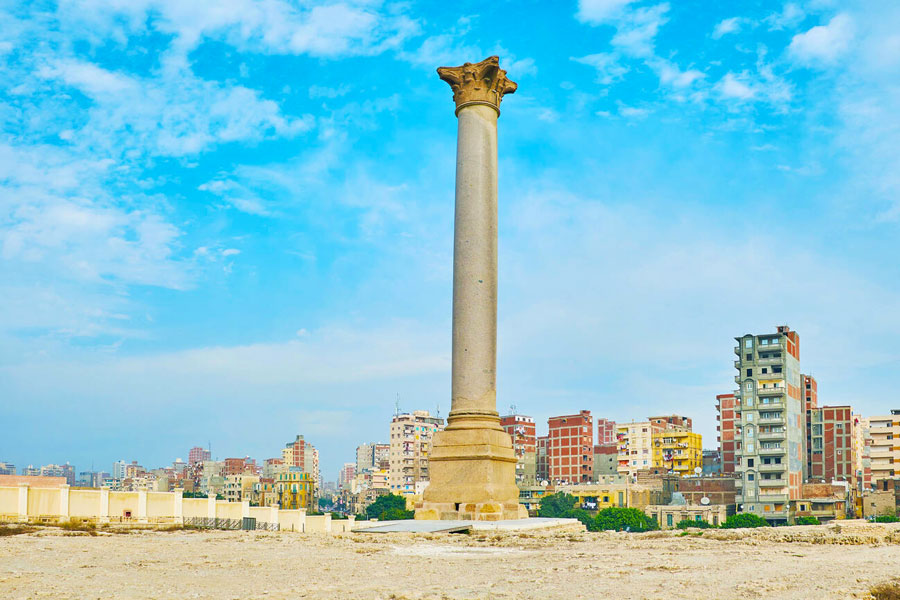
Welcome to Pompey's Pillar — known in Arabic as El Sawary, 'the columns' — the most visible ancient monument in Alexandria and one of the largest ancient monolithic columns in the world.
Despite its popular name, the pillar has nothing to do with the Roman general Pompey. It was actually erected in 297 AD in honor of the Emperor Diocletian, to celebrate his victory over a revolt in Alexandria and his gift of grain to the city's population. The 'Pompey' name was a medieval European misidentification that has stubbornly persisted.
The pillar stands approximately 27 meters tall — about 9 stories — and is cut from a single piece of red Aswan granite. The shaft alone is 20.46 meters high and 2.7 meters in diameter, sitting on a massive base of older stone. It is the largest monolithic column ever erected outside the city of Rome, and the sheer engineering achievement of quarrying, transporting, and erecting such a stone in antiquity is staggering.
The pillar originally stood within the precinct of the Serapeum — the great temple of Serapis, the Greco-Egyptian god who combined elements of Osiris, Apis, and Greek deities. The Serapeum was one of the most magnificent temples in the ancient world, and its attached library may have been a daughter institution of the Great Library. The temple was destroyed by a Christian mob in 391 AD, and only the pillar and some underground galleries remain.
At the base of the pillar, two pink granite sphinxes recline on pedestals, and the underground galleries of the Serapeum — where sacred Apis bulls were worshipped — can be visited nearby.