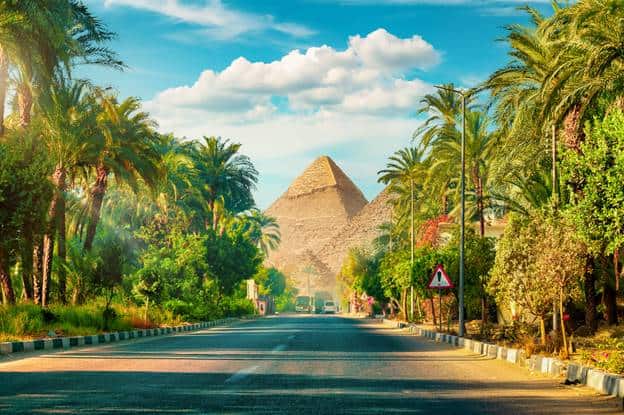
Welcome to Giza — one of the most iconic landscapes on Earth, where the desert meets the edge of Cairo and the ancient world meets the modern.
The Giza Plateau rises dramatically from the floodplain of the Nile, a limestone escarpment that the ancient Egyptians chose as the burial ground for their most powerful pharaohs during the Old Kingdom period, roughly 4,500 years ago.
Giza today is technically a governorate of Greater Cairo, its edges increasingly absorbed by the city's suburban sprawl. Yet the plateau itself remains a world apart — the three Great Pyramids of Khufu, Khafre, and Menkaure standing exactly as they have for millennia, surrounded by smaller queens' pyramids, the ruins of mortuary temples, and the enigmatic Great Sphinx.
The scale of what was built here is almost beyond comprehension. The Great Pyramid of Khufu — the oldest and largest — was the tallest man-made structure on Earth for nearly 4,000 years. It contains an estimated 2.3 million stone blocks, each weighing between 2.5 and 15 tonnes.
Beyond the pyramids, Giza is also home to ancient boat pits, the Solar Boat Museum, and the spectacular Grand Egyptian Museum — one of the largest archaeological museums in the world — which opened nearby to house the treasures of Tutankhamun and thousands of other artifacts.
Giza is best visited at dawn, when the plateau is quiet and the rising sun catches the limestone faces of the pyramids in golden light.