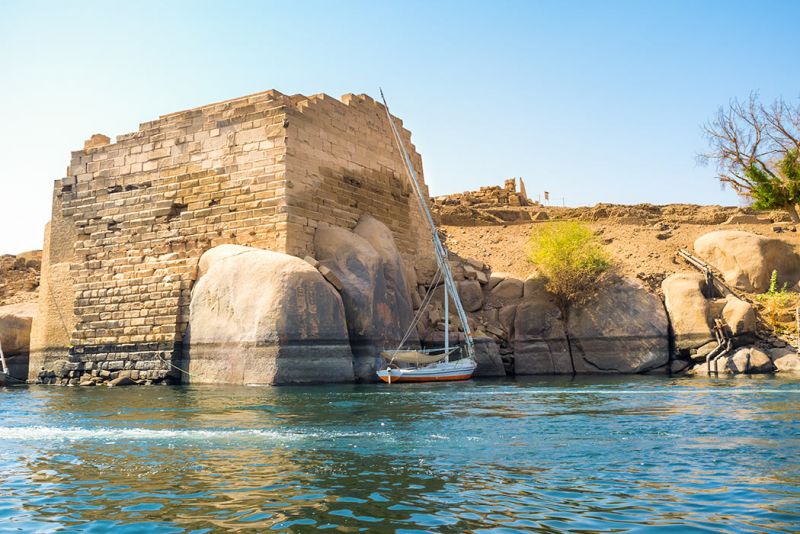
Welcome to Elephantine Island — the ancient heart of Aswan, sitting in the middle of the Nile surrounded by golden granite boulders and rushing blue water.
The island's name in ancient Egyptian was Abu — meaning 'elephant,' either because of its shape from above, the large rounded granite boulders that resemble bathing elephants, or because it was the center of the ivory trade from sub-Saharan Africa. The Greeks translated this as Elephantine, and the name has endured for 5,000 years.
For most of ancient Egyptian history, Elephantine was one of the most strategically important places in the country. It stood at the First Cataract — the natural boundary between Egypt and Nubia — making it the frontier town where Egypt's southern border was defended, taxed, and monitored. Every expedition sent south into Africa, every merchant bringing gold, ivory, and exotic animals, passed through Elephantine.
The island contains significant archaeological remains spanning thousands of years. The Temple of Khnum — the ram-headed god of the Nile flood who was Aswan's principal deity — once stood here, along with a nilometer, a graduated stone staircase used to measure the annual Nile flood and predict the coming year's harvest and taxes.
The Aswan Museum, set in a charming colonial-era villa on the island, houses artifacts discovered in the local excavations — mummies, pottery, jewelry, and statues spanning from prehistoric times to the Islamic period.
Today, two Nubian villages occupy the northern part of the island — colorful communities of painted houses, gardens, and friendly residents who offer a living glimpse of Nubian culture. Reaching the island by ferry, with the Nile breeze and the view of Aswan's Corniche across the water, is one of the great pleasures of visiting Aswan.