About this place
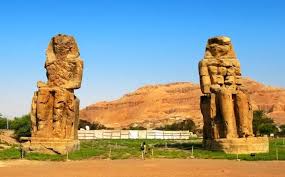
Stand before the two massive stone statues of Pharaoh Amenhotep III that have guarded the West Bank for over 3,400 years, once marking the entrance to his mortuary temple.

Colossi of Memnon
Luxor, Egypt
Audio Guide
Listen at your own pace · Available in 5 languages
Colossi of Memnon — English

Colossi of Memnon
The Colossi of Memnon (Arabic: el-Colossat or es-Salamat) are two large stone statues of the Pharaoh Amenhotep III, which stand at the front of the ruined Mortuary Temple of Amenhotep III, the largest temple in the Theban Necropolis. They have stood since 1350 BC, and were well known to ancient Greeks and Romans, as well as early modern travelers and Egyptologists. The statues contain 107 Roman-era inscriptions in Greek and Latin, dated to between AD 20 and 250; many of these inscriptions on the northernmost statue make reference to the Greek mythological king Memnon, whom the statue was then erroneously thought to represent.
Scholars have debated how the identification of the northern colossus as "Memnon" is connected to the Greek name for the entire Theban Necropolis as the Memnonium.
🧠 Test Your Knowledge
History Quiz
5 questions · Earn a badge
Test your knowledge of what you just heard. Score 60% or higher to earn a quiz badge on your Passport!