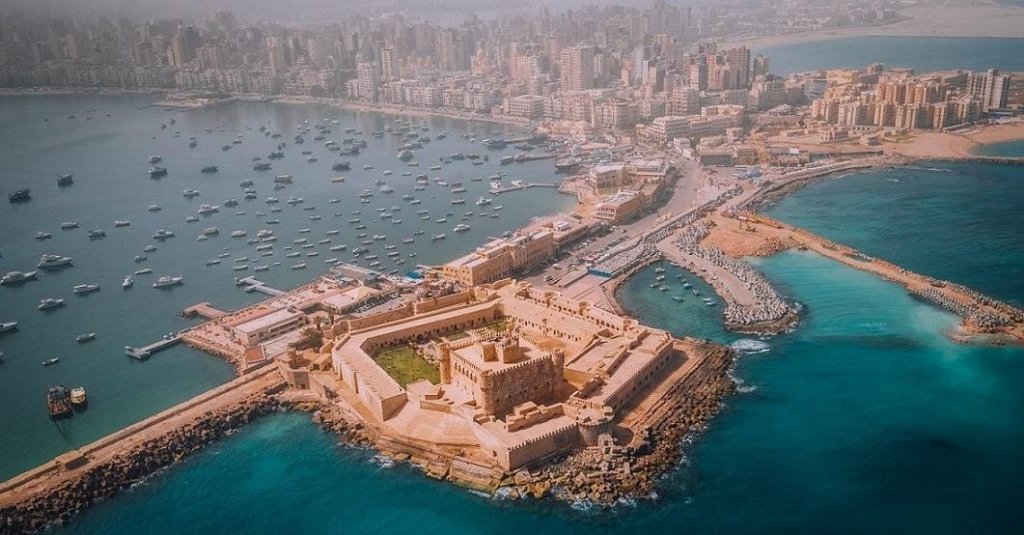
Welcome to the Citadel of Qaitbay — one of the most dramatically positioned fortresses in Egypt, standing at the very tip of Alexandria's Eastern Harbor peninsula, built on one of the most famous sites in the ancient world.
Beneath the citadel's foundations lie the remains of the Pharos of Alexandria — the Great Lighthouse, one of the Seven Wonders of the Ancient World. Built around 280 BC by Ptolemy II, the Pharos stood between 100 and 140 meters tall — an extraordinary engineering achievement — and guided ships into Alexandria's harbor for nearly a thousand years. It was damaged by a series of earthquakes in the 10th through 14th centuries and finally collapsed in the 1300s.
When the Mamluk Sultan Qaitbay built his fortress in 1477, he used the fallen stones of the lighthouse — including massive granite blocks — as building material. Archaeologists have found fragments of the original Pharos, including giant sphinxes and royal statues, in the waters around the citadel, where they fell when the lighthouse collapsed.
The Citadel of Qaitbay is itself a superb example of Mamluk military architecture — compact, elegant, and powerfully built, with a central tower keep, thick curtain walls, and a moat. It was built to defend against Ottoman naval attacks.
From the citadel's ramparts, the views are spectacular — the sweep of Alexandria's Eastern Harbor, the Corniche, the city skyline, and the open Mediterranean stretching to the horizon.
Today the citadel houses a small naval museum and remains one of Alexandria's most visited and beloved landmarks. Standing here, you are standing on one of the most layered and historically resonant spots in the ancient world.