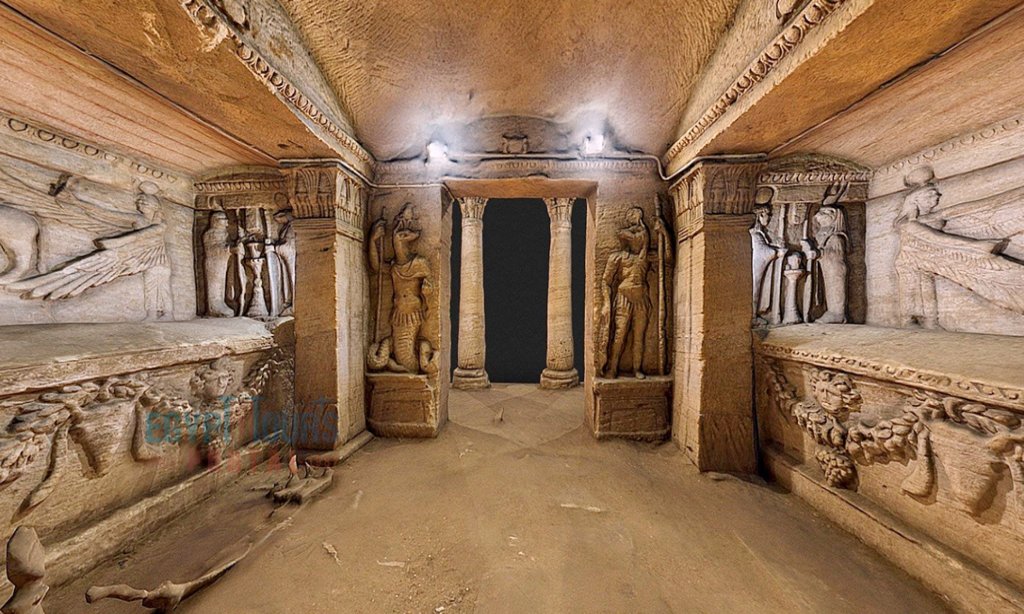
Welcome to the Catacombs of Kom el-Shoqafa — one of the Seven Wonders of the Middle Ages, and the largest known funerary complex in Egypt.
The name Kom el-Shoqafa means 'Mound of Shards' in Arabic, referring to the broken pottery vessels found here — the remnants of food and drink left as offerings, or smashed by mourners after funeral banquets held on site.
The catacombs were carved from solid rock in the 2nd century AD and were in use until the 4th century. They were rediscovered only in 1900, when a donkey accidentally fell into the shaft — an appropriately dramatic entry for such a remarkable find.
Descending into the catacombs is like descending through time. Three levels of chambers and corridors spiral downward into the rock, accessible via a spectacular circular staircase winding around a central shaft.
What makes Kom el-Shoqafa extraordinary is the extraordinary fusion of artistic styles found within. The principal tomb chamber mixes Egyptian, Greek, and Roman iconography in a way seen nowhere else — Anubis, the Egyptian god of embalming, is depicted wearing Roman armor; Egyptian gods are shown with Greek facial features; pharaonic reliefs are framed by Roman architectural motifs.
This cultural fusion reflects Alexandria itself — a city where Egyptian, Greek, Jewish, and Roman civilizations coexisted for centuries, borrowing and blending each other's traditions.
The Triclinium — a large dining hall carved adjacent to the tombs — was used for funerary banquets, where the living dined in the presence of the dead. The acoustics, the carved benches, and the haunting quality of the underground space make it one of the most atmospheric ancient sites in Egypt.